

(Levens)kunst on Aegina
Originally published in the Summer Edition of the Dutch Griekenland Magazine in June 2026
Text and photography: Wytske Roodbergen
English adaptation for web publication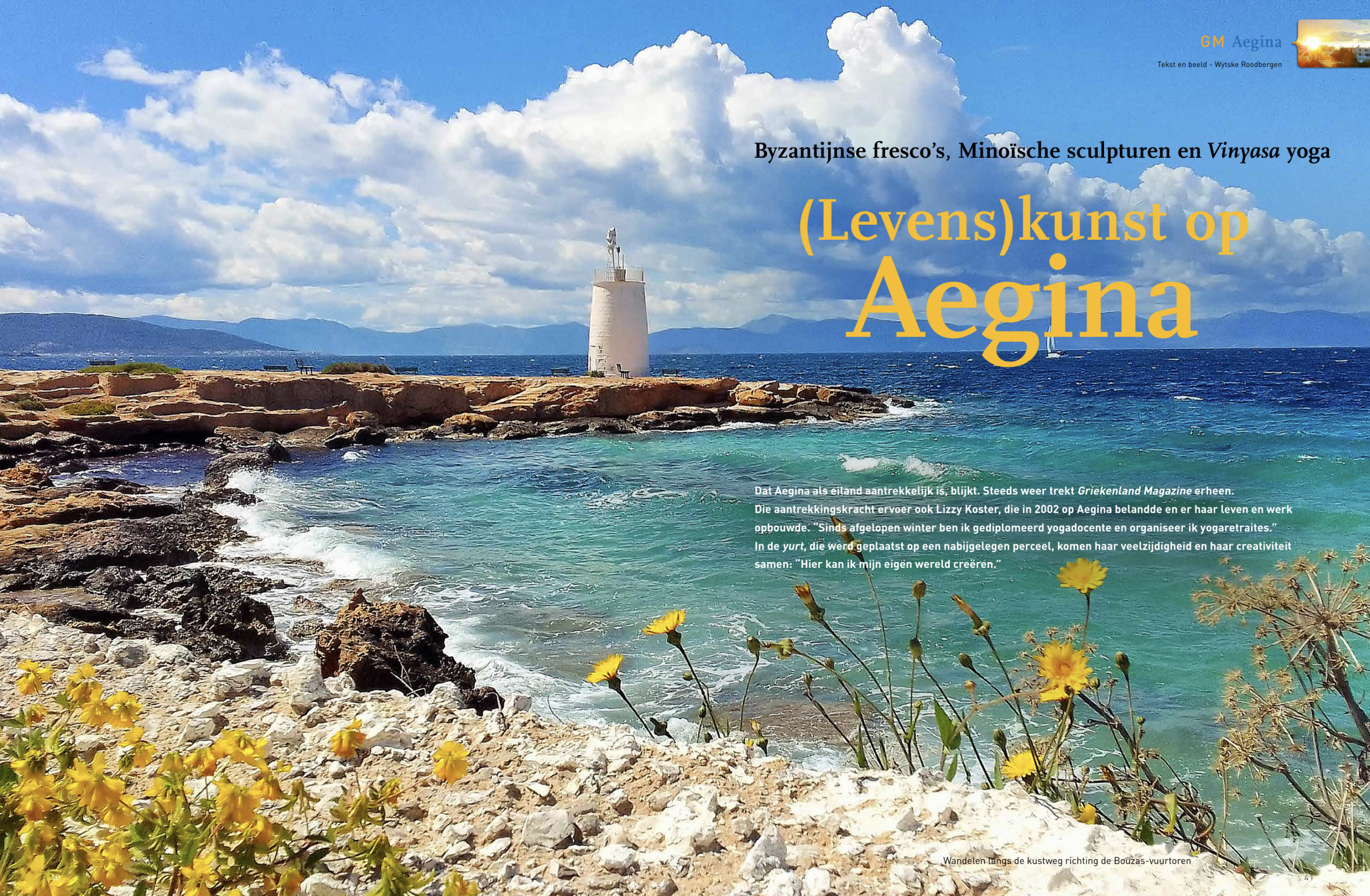
The Art of Living on Aegina
Byzantine Frescoes, Minoan Sculptures and Vinyasa Yoga
The appeal of Aegina as an island is undeniable. Time and again, Griekenland Magazine finds its way back here. Lizzy Koster experienced that same attraction when she arrived on Aegina in 2002 and gradually built her life and work on the island.
“Since last winter I have been a certified yoga teacher and I now organize yoga retreats.”
In the yurt, located on a nearby plot of land, Lizzy’s versatility and creativity come together.
“Here I can create my own world.”
Lizzy
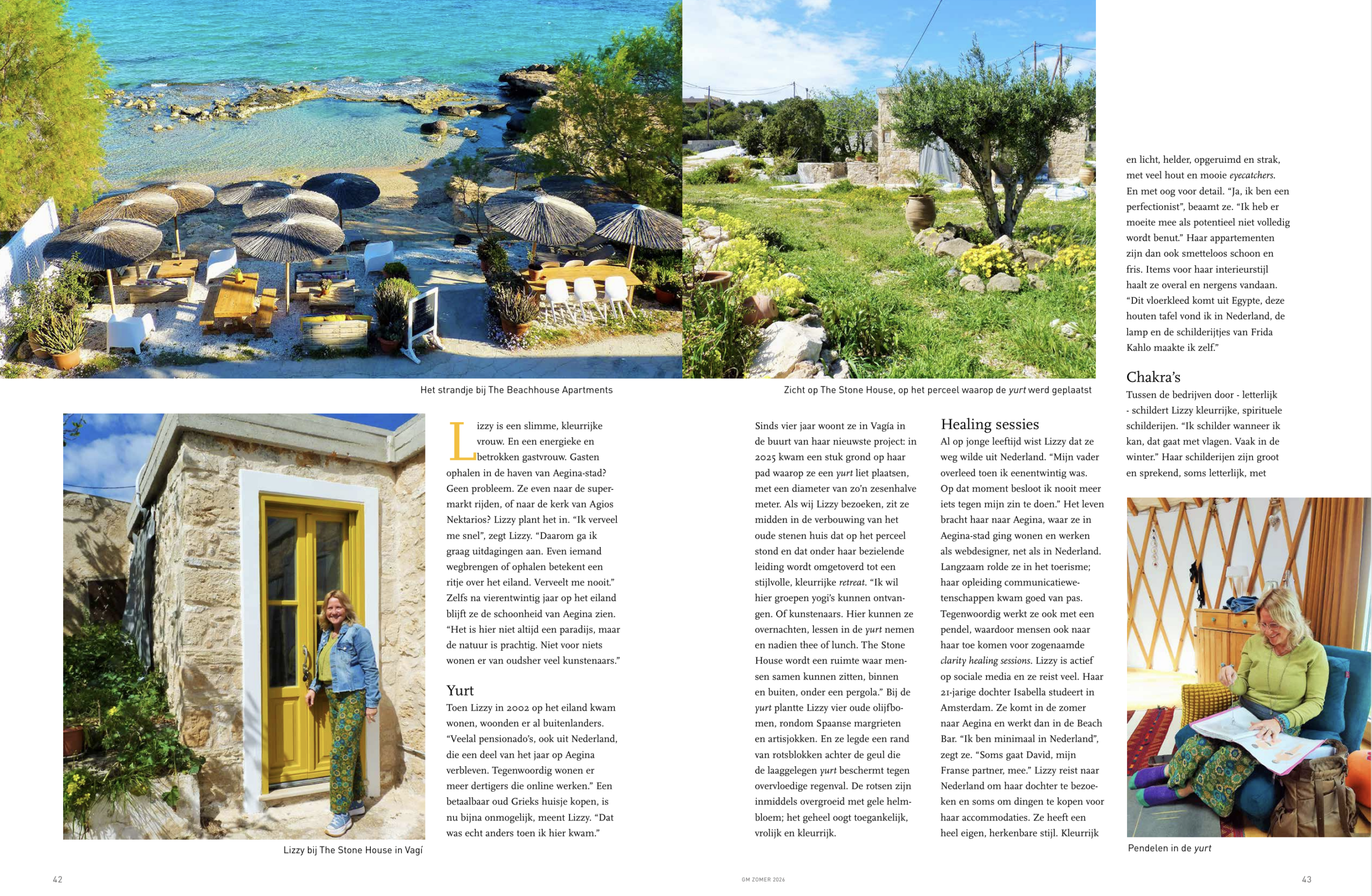
Lizzy is an intelligent, colourful woman, as well as an energetic and involved hostess.
Picking up guests from the port of Aegina Town? No problem. Driving them to the supermarket or to the church of Agios Nektarios? Lizzy will fit it into her schedule.
“I get bored quickly,” she says. “That is why I enjoy taking on challenges. Driving someone somewhere or picking them up means another trip across the island. I never get tired of it.”
Even after twenty-four years on Aegina, she continues to appreciate the island’s beauty.
“It is not always paradise here, but nature is beautiful. There is a reason why artists have been coming here for generations.”
The Yurt
When Lizzy settled on Aegina in 2002, many of the foreigners living on the island were retirees, including quite a few from the Netherlands, who spent part of the year here.
“Nowadays you see many more people in their thirties working online,” she says.
According to Lizzy, buying an affordable old Greek house has become almost impossible.
“That was very different when I arrived.”
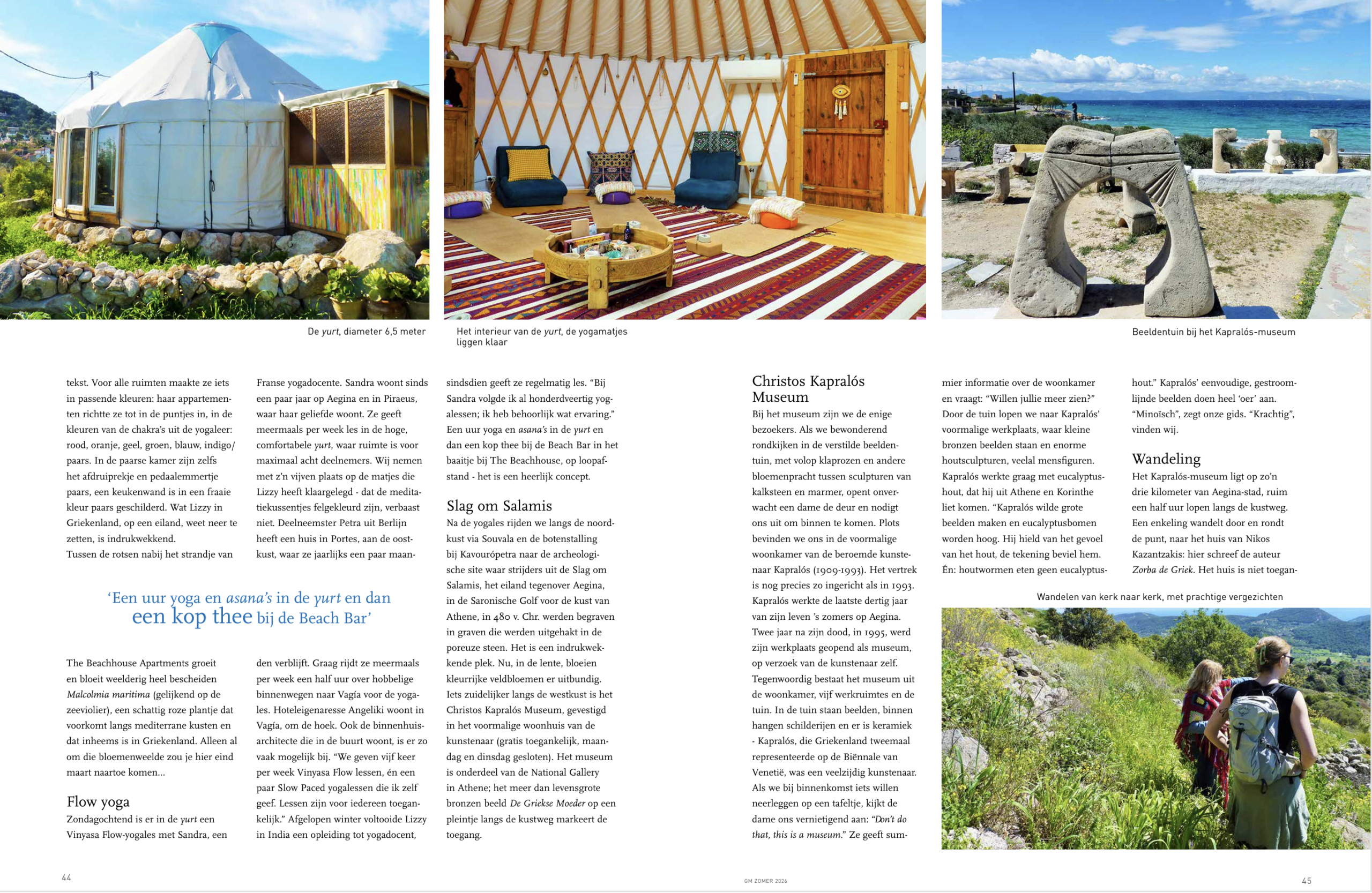
For the past four years, she has lived in Vagia, close to her newest project. In 2025 she installed on a plot of land a yurt with a diameter of approximately six and a half metres.
When we visit her, she is in the middle of renovating the old stone house standing on the property. Under her inspired guidance it is being transformed into a stylish and colourful retreat.
“I would like to welcome groups of yogis here, artists or clients for my clarity sessions. They can stay overnight, take sessions in the yurt, and afterwards enjoy tea or lunch. The Stone House will become a place where people can gather, both indoors and outdoors, under a pergola.”
Around the yurt, Lizzy planted four old olive trees, Spanish daisies and artichokes. She also created a protective border of rocks behind the drainage channel that protects the low-lying yurt from heavy rainfall.
The rocks are now covered with yellow flowers, giving the whole place a welcoming, cheerful and colourful atmosphere.
Clarity Sessions
At a young age, Lizzy already knew she wanted to leave the Netherlands.
“My father passed away when I was twenty-one. At that moment I decided that I would never again do something against my own will.”
Life eventually brought her to Aegina, where she first lived and worked in Aegina Town as a web designer, just as she had done in the Netherlands.
Gradually she became involved in tourism, where her degree in Communication Sciences proved valuable.
Today she also works with a pendulum, and people visit her for what she calls Clarity Sessions.
Lizzy is active on social media and travels regularly. Her daughter Isabella, now twenty-one, studies in Amsterdam. During the summer she comes to Aegina and works at the Beach Bar.
“I spend very little time in the Netherlands,” Lizzy says. “Sometimes David, my French partner, comes with me.”
Most visits to the Netherlands are to see her daughter or to find special items for her accommodations.
Lizzy has developed a very distinctive style: colourful yet light, bright, organised and clean, with plenty of wood, striking details and a strong eye for design.
“Yes, I am a perfectionist,” she admits. “I find it difficult when potential is not fully used.”
Chakras
Alongside her many activities, Lizzy paints colourful and spiritual artwork.
“I paint whenever I can,” she says. “It comes in waves, often during the winter.”
Her paintings are large, expressive and sometimes quite literal, incorporating text as well as images.
For every space she has created a matching colour scheme. The apartments at The Beachhouse Apartments are decorated down to the smallest detail in the colours of the chakras from the yogic tradition: red, orange, yellow, green, blue, indigo and violet.
In the purple apartment, even the dish-drainer and pedal bin are purple, while one of the kitchen walls is painted in a beautiful shade of violet.
What Lizzy has created here in Greece, on a small island, is impressive.
Between the rocks near the little beach of The Beachhouse Apartments grows Malcolmia maritima, a delicate pink flower native to Greece and common along Mediterranean coastlines. The spring bloom is so beautiful that it alone would be reason enough to visit Aegina at the end of March.
Flow Yoga
On Sunday morning, a Vinyasa Flow yoga class takes place in the yurt, led by Sandra, a French yoga teacher.
Sandra has lived partly on Aegina and partly in Piraeus for several years, where her partner lives. She teaches several classes each week in the spacious and comfortable yurt, which accommodates up to eight participants.
The five of us settle onto the yoga mats Lizzy has prepared. It comes as no surprise that the meditation cushions are brightly coloured.
One participant, Petra from Berlin, owns a house in Portes on the east coast of Aegina and spends several months there every year. She gladly drives half an hour along the island’s winding roads several times a week to attend yoga classes in Vagia.
Angeliki, who owns a local hotel, lives just around the corner, while a nearby interior designer joins whenever possible.
“We offer five Vinyasa Flow classes each week, as well as several Slow Paced classes that I teach myself,” says Lizzy. “The classes are accessible to everyone.”
Last winter, Lizzy completed her yoga teacher training in India and has been teaching regularly ever since.
“I have already taken around 140 yoga classes with Sandra, so I have gained quite a lot of experience.”
An hour of yoga and asanas in the yurt, followed by a cup of tea at the Beach Bar in the small bay beside The Beachhouse Apartments, all within walking distance, is a wonderful concept.
The Battle of Salamis
After yoga, we drive along the northern coast via Souvala and the boatyard at Kavourópetra to the archaeological site where warriors from the Battle of Salamis were buried.
The battle took place in 480 BC in the Saronic Gulf, between Athens and the island of Salamis opposite Aegina. The graves were carved directly into the porous rock.
It is an impressive location.
Now, in spring, colourful wildflowers bloom abundantly around the site.
A little further south along the west coast lies the Christos Kapralos Museum, housed in the former home of the artist. Admission is free, although the museum is closed on Mondays and Tuesdays.
Part of the National Gallery of Athens, the museum is marked by the monumental bronze sculpture The Greek Mother standing near the coastal road.
Christos Kapralos Museum
When we arrive, we are the only visitors.
As we admire the peaceful sculpture garden, filled with poppies and colourful flowers growing among limestone and marble sculptures, a woman unexpectedly opens the door and invites us inside.
Suddenly we find ourselves in the former living room of the renowned artist Christos Kapralos (1909–1993).
The room remains exactly as it was in 1993.
Kapralos spent the last thirty summers of his life working on Aegina. Two years after his death, in 1995, his studio was opened as a museum at his own request.
Today the museum consists of the living room, five workspaces and the garden.
Outside stand sculptures; inside are paintings and ceramics. Kapralos, who represented Greece twice at the Venice Biennale, was a remarkably versatile artist.
When we attempt to place something on a small table near the entrance, our guide immediately corrects us.
“Don’t do that, this is a museum.”
She briefly explains the room and then asks:
“Would you like to see more?”
Through the garden we enter Kapralos’ former workshop, where small bronze sculptures stand alongside enormous wooden figures.
Kapralos loved working with eucalyptus wood, which was transported from Athens and Corinth.
“He wanted to create large sculptures,” our guide explains. “Eucalyptus trees grow tall. He loved the feel of the wood and the patterns within it. And woodworms do not eat eucalyptus.”
Kapralos’ simple, flowing sculptures feel almost primordial.
“Minoan,” says our guide.
“Powerful,” we agree.
A Walk Along the Coast
The Kapralos Museum lies about three kilometres from Aegina Town, a pleasant half-hour walk along the coastal road.
Some visitors continue around the headland towards the house of Nikos Kazantzakis, where the author of Zorba the Greek once lived. The house itself is not open to the public.
Along the route, strategically placed benches invite visitors to stop and enjoy the views.
At the end of March, the scenery is spectacular: dramatic skies, wind, foaming waves, vibrant colours and seemingly endless vistas.
Spring on Aegina is beautiful, although rainy days with storms, thunder and rough seas are not uncommon.
Along the way we recognise white and yellow chamomile, hawkweed, crown daisies and the bright fuchsia flowers of the Hottentot Fig, a coastal plant with thick fleshy leaves. The variety of wildflowers is remarkable.
Passing the nine-metre-high white Bouzas Lighthouse, we continue towards the small waterfront restaurants near Kolona, where we are meeting our friend Yiota for Sunday lunch.
She has travelled especially from Piraeus for the afternoon, demonstrating just how accessible Athens is from Aegina.
“I’m at the restaurant with the blue chairs,” she messages.
Our reunion at Taverna Maistrali is warm and relaxed. Sardines, courgette fritters, fries, salad and bougiourdi—baked feta with tomato and peppers—make for a perfect lunch.
At the end of the day, Yiota takes the ferry back to Piraeus while we catch a taxi to Vagia. Buses only run twice daily between Aegina Town and Vagia, and on Sundays the last one departs at one o’clock in the afternoon.
The drive through the quiet countryside across the island is unforgettable.
Paleochora – The Old Capital
On a bright morning we drive to Paleochora, literally “the old town.”
From the ninth century until the beginning of the nineteenth century, Paleochora was the capital of Aegina.
The inhabitants moved inland and uphill to protect themselves from pirate attacks. The settlement was built against a hillside close to the Monastery of Saint Nektarios.
Once the danger had passed, the population gradually returned to the harbour area. The old town was abandoned and most of its houses eventually fell into ruin.
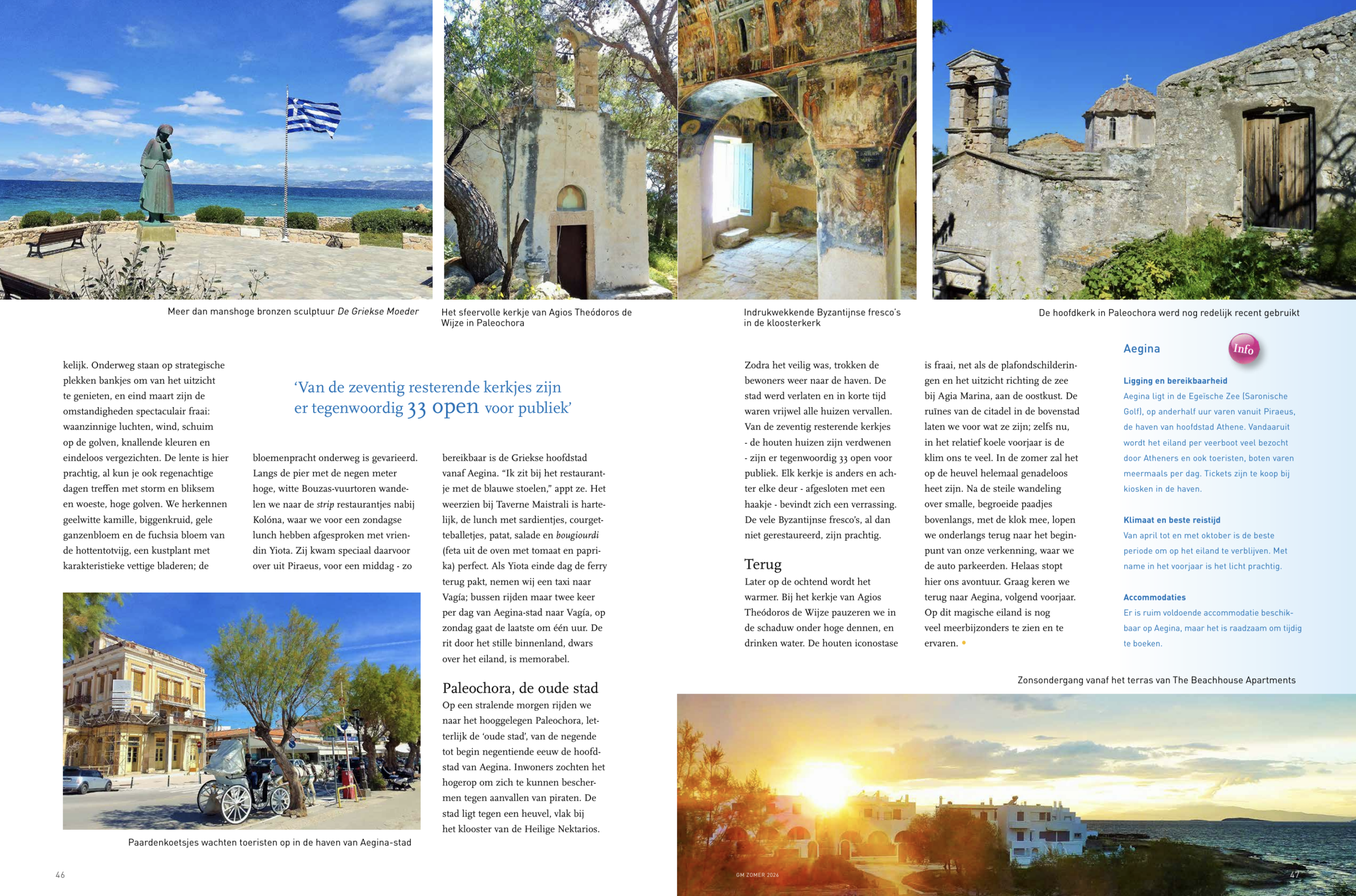
Of the approximately seventy churches that remain—the wooden houses have disappeared—thirty-three are now open to the public.
Every church is different and behind each small door, secured with a simple latch, lies a surprise.
The many Byzantine frescoes, some restored and others untouched, are beautiful.
Returning
Later in the morning the temperature rises.
At the small church of Agios Theodoros the Wise, we pause beneath tall pine trees and drink some water.
The wooden iconostasis is beautiful, as are the ceiling paintings and the view towards the sea near Agia Marina on the east coast.
We decide not to climb to the ruins of the citadel in the upper town. Even in the relatively cool spring weather, the ascent feels demanding. In summer the heat on the hillside must be relentless.
Following narrow overgrown paths, we make our way back to the starting point of our exploration.
Unfortunately, this is where our adventure ends.
We would gladly return to Aegina next spring.
On this magical island there is still so much more to discover and experience.