Go back to home page spacer
SHARE:  
culture_article_index_1
 
culture_article_index_2
 

home > culture & religion > index

Culture & religion


Aegina's Medieval Village of Paleachora   Aegina's Medieval Village of Paleachora
Aegina's version of Mystras
On a steep hill adjacent to the church and monastery of Agios Nektarios is located Aegina's version of Mystras - Paleachora, which means literally, Old Town, and which was for a millennium (9th century - early 19th century AD) the island capital. The setting itself is magnificent, especially in spring, when all vegetation is a brilliant green both on the hill and in the valley below .... Further reading

All about the Temple of Afea   All about the Temple of Afea
An interview with Ernst-Ludwig Schwandner - archaeologist.
On the site of the 5th century BC Doric temple of Afea/ Aphaia in northeastern Aegina, an earlier temple existed from 570-510 BC which was destroyed by fire. Its partial reconstruction is found in the inner portion of the Afea museum. This remarkable work was carried out by a man known locally by the Greek name Ludovikos. Further reading

The monastery of Agios Nektarios   The monastery of Agios Nektarios
A massive, recently-built church sits up on a hill in the inland area known as Kontos on Aegina island, just a few miles from the port. Built for the most recent Greek Orthodox saint - Agios Nektarios - it is visited by large numbers of people every year, many of them seeking help from this miracle-working saint, who died in 1920 .... Further reading

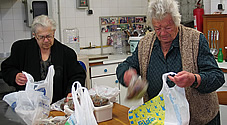
Leousio Foundation Aegina   The Leousio Foundation of Aegina
For 20 years, this church-run Aegina foundation has provided regular, daily meals to elderly people on the island, some of whom are bedridden, others without any pension, without children, but in general unable to eat well without the support of the foundation. Meals are cooked and delivered to them daily by volunteers, all free of charge .... Further reading

Pachia Rachi - hill village of stone houses   Pachia Rachi
Hill village of stone houses
Up until the 1950s, Aegina's mountain village of Pachia Rachi was the main village on the slopes of Mount Oros, which is the island's highest peak, at 532 metres. It has been officially proclaimed a traditional settlement by the Greek Ministry of Culture, and though neglected for many years and nearly abandoned, many of its houses have been restored during recent decades .... Further reading

Vagia - a little known Aegina Village   Vagia
A little-known Aegina village
This corner of the island is largely covered with pine-forested hills, the lovely valley with the larger, spread-out village of Mesagros nestled below them. The children from the old tiny village of Vagia (by the sea to its northeast) walked barefoot for one hour to school there, and when older, a full two hours to the middle school (gimnasio) in the Aegina's harbour city. This was how it was up until the 1950s .... Further reading

Zors Sarri - More on Aegina's Vagia Village   More on Aegina's Vagia Village
About Zorz Sarri and her books about the village of Vagia
Ta Stena Papoutsia, written by Zorz Sarri - Ζωρζ Σαρή, is like her first book, O Thisavros tis Vagias** (The Treasure of Vagia) set in the village of Vagia, during the 1930s, where Sarri spent some of her childhood summers. She is one of the most important modern Greek authors of children's literature .... Further reading

Old Aegina Villages Houses   Old Aegina Villages Houses
Architecture on Aegina
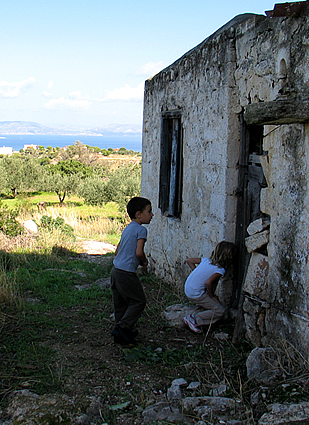
A very impressive school project was carried out in the Aegina village of Mesagros in 2010 by the elementary school teacher, Maria Chaldeou. Together, and pupils engaged in an exploration of some of the older village houses of Mesagros and neighbouring Vagia, visiting and exploring several of them, and then writing up accounts of these explorations. .... Further reading

An Aegina village home in the 19th century   An Aegina village home in the 19th century
What would the house of a well-to-do farmer in Aegina have been like in the 19th century?
In conversation with Mrs Lina Bogri Petritou, well-known for her talks and writing on the subject of life in Aegina in times gone by. She tells us some of her memories of her grandfather's stories of life in 19th century Aegina .... Further reading

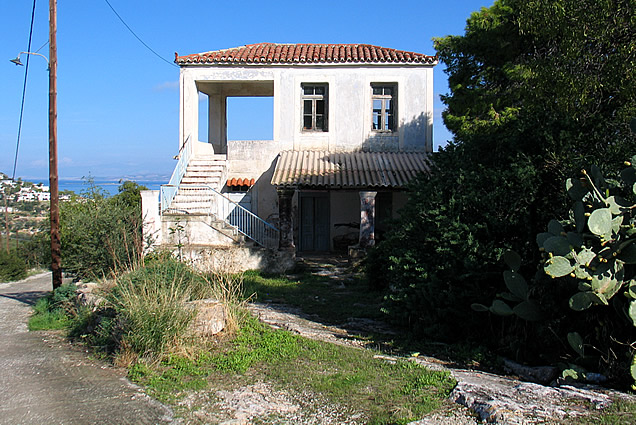
The House of Rodakis   The House of Rodakis
A perishing monument in Mesagros on Aegina
Alexandros Rodakis, a simple farmer, lived in the 19th century in Messagros. A special man, with remarkable perception, who projected his sensitive inner world in everyday life activities; when labouring at ploughing, sweating at cropping, enjoying the local feasts and setting up his house, which he built around 1880 .... Further reading

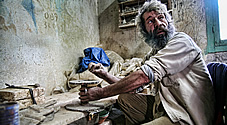
An interview with potter Nektarios Garis   Pottery and Food in the Old Aegina Village
An interview with potter Nektarios Garis from Mesagros
The interview with one of the last scions of the pottery-making families of Aegina - in the large spread-out inland village of Mesagros - began with a discussion about local agriculture and preparation of food. Thinking on this later, this seemed fitting to me, since ceramic wares have long been connected with food - with vessels for cooking, storing and serving of food and drink. .... Further reading

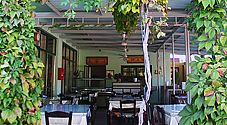
Vachos - an outstanding Aegina country taverna   Βακχος "Vachos"
An outstanding Aegina country taverna
Vachos - taverna which many consider to be Aegina's finest - named for the god of wine and the grapevine. his fine, family-run, 32-year old taverna is located on the back road between Vagia and Mesagros, the road leading inland from the main seaside village of Vagia in the island's northeast corner .... Further reading


AeginaGreece.com - The ultimate Aegina Internet Guide


© 2011 AEGINAGREECE.COM - made by  WEB GIRL INTERNET SERVICES